
Whether you’re measuring wood for a DIY project or helping your child with homework, knowing how to read a ruler is a fundamental skill. Rulers come in different units and scales. This guide walks you through reading both standard (imperial) and metric rulers, including inches, centimeters, and millimeters.
How to Read a Ruler in Inches
The most common ruler in the U.S. is the 12-inch (1-foot) standard ruler. Each inch is divided into smaller fractional units, usually down to 1/16 of an inch. Understanding these fractions is the key to reading an imperial ruler correctly.
How the Inch Markings Work
- Whole inches are shown by the longest vertical lines and are usually numbered (1, 2, 3, etc.).
- ½-inch (one-half) marks are the second-longest lines between the whole inches (if present).
- ¼-inch (one-quarter) marks divide each inch into four parts (if present).
- ⅛-inch (one-eighth) marks divide each inch into eight equal parts.
- 1⁄16-inch (one-sixteenth) marks are the smallest lines and divide the inch into sixteen equal parts.
The more divisions in the fraction, the shorter the marking on the ruler. Learning to recognize these line lengths makes it easier to read measurements quickly.
The image below shows a ruler with inches on one side and centimeters on the other. Each inch is divided into 16 equal parts—the smallest tick marks represent 1⁄16 inch. The slightly longer lines mark 1⁄8 inch divisions. This ruler does not have the quarter or half inch markings.

How to Actually Read a Ruler Measurement in Inches
- Place the object so that one end lines up with the “0” mark on the ruler (not the physical edge of the ruler, which may be worn or uneven).
- Find the point where the other end of the object lands.
- Locate the nearest whole-inch mark first, because that gives you the base measurement.
- Identify the fractional mark just past the end of the object.
- For example, if the object ends after the 3-inch mark but before the 4-inch mark, find the exact fractional line it aligns with, such as 3⅜″ or 3⁵⁄₁₆″.
- Combine the whole inches with the fraction to get the final measurement.
Example:
If the end of your object lines up with the third 1/8-inch mark after the 2-inch line, your measurement is 2⅜ inches.
How to Read an Engineering Inch Ruler

The ruler shown in the image includes two different measurement scales: a decimal-inch scale on one side and a fine fractional scale on the other. This makes the ruler useful for both general measurements and high-precision work.
The “20” Side — Decimal Inches
The side marked “20” divides each inch into 20 equal parts instead of the usual fractions. This is a decimal-inch scale.
- Each small tick = 0.05 inch
- Every 5th mark = 0.25 inch
- Longer marks = 0.50 inch and full inches
This type of scale is commonly used in engineering or machining where decimal values are easier to work with than fractions.
The “32” Side — Fractional Inches
The opposite side, marked “32,” divides each inch into 32 smaller parts.
- Each tick = 1⁄32 inch
- Longer marks show 1⁄16, 1⁄8, 1⁄4, 1⁄2, and full inches
This side provides very fine fractional precision ideal for woodworking, metalwork, or any task requiring tight tolerances.
How Do You Read a Centimeter Ruler?
Metric rulers are commonly used in science, engineering, woodworking, tailoring, and in most countries outside the U.S. They are straightforward to read because they use a simple base-10 system. The following image shows a centimeter ruler with millimeter subdivisions.

Understanding the Markings
- Each large numbered mark represents 1 centimeter (cm).
- Between each centimeter are 10 smaller divisions, and each one equals 1 millimeter (mm).
- Since there are 10 mm in each cm, a measurement like 3.7 cm simply means 3 centimeters and 7 millimeters.
How to Take a Measurement with a Centimeter Ruler
- Place the object so that one end lines up with the “0” mark on the ruler—not the physical edge.
- Look along the ruler to see where the other end of the object falls.
- Read the last whole centimeter mark first.
- Then count the additional millimeter marks beyond that point.
- Combine them for your final measurement in either cm or mm.
Example:
If an object lines up with the 4 cm mark plus 5 small marks beyond it, the measurement is:
- 4 cm + 5 mm = 4.5 cm, or
- 45 mm if you prefer millimeters.
This method gives clear, accurate metric measurements and makes it easy to switch between centimeters and millimeters depending on what your task requires.
How to Read Millimeters on a Ruler
If you’re wondering: how do you read mm on a ruler?, look for the smallest lines between the centimeter marks. Each of these tiny lines is exactly 1 millimeter.
There are 10 millimeters in each centimeter. This means a 30 cm ruler includes 300 millimeters. This level of precision is useful in tasks like engineering or tailoring.
How Do You Read Measurements on a Ruler?
To read measurements on a ruler, start at the “0” line, not the edge of the ruler. Place the ruler’s zero mark exactly at one end of the object. Then read the mark at the other end. Use inches or centimeters depending on the ruler and your needs.
This basic process answers both “how do you measure with a ruler” and “how do you read measurements on a ruler.”
How to Use a Ruler to Measure Accurately
Using a ruler correctly involves more than reading numbers. Here’s how to measure accurately:
- Always align the ruler’s zero mark with the starting point of what you’re measuring.
- Keep the ruler flat and straight.
- Look straight down at the measurement for an accurate reading.
This technique works the same whether you’re using a ruler in inches or a metric ruler.
How to Read a Decimal Ruler
A decimal ruler is a variation that divides each inch into 10, 20, 50, or 100 equal parts instead of fractions. These are useful in technical or engineering fields.
To read a decimal ruler, simply count the number of divisions from zero and multiply it by the decimal value represented by each tick mark.
How Do You Read a Scale Ruler?
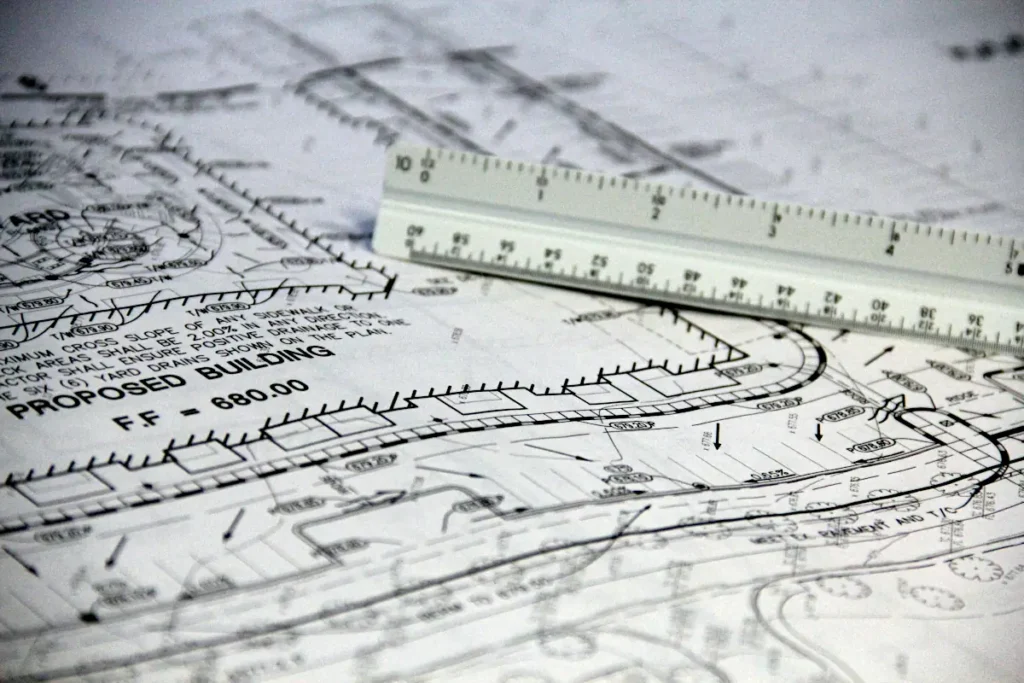
A scale ruler is used for architectural, engineering, and technical drawings where the objects on paper are drawn smaller than their real-world size. Instead of measuring in inches or centimeters, a scale ruler converts the measurement directly into the real dimension using a ratio such as 1:50, 1:100, or 1/4″ = 1′.
How to Use a Scale Ruler
- Identify the scale used on the drawing.
Look for labels like Scale: 1:50, 1:100, or 1/4 inch = 1 foot. This tells you which side of the scale ruler you need. - Find the matching scale on your scale ruler.
Scale rulers have multiple numbered edges, each corresponding to a specific ratio. Choose the one that matches the drawing. - Align the zero point with the start of the line you want to measure.
Most scale rulers have a zero mark offset from the end, so begin at the correct zero point—not the physical end of the ruler. - Read the number where the line ends.
The number you read is the real-world measurement, not the length on paper.
Example of Reading a Scale Ruler
If you are using a drawing labeled 1:50 scale and the wall on the drawing measures up to the “4” mark on the 1:50 scale edge, then the actual wall length is:
- 4 meters in real life
(because each numbered unit on the 1:50 scale represents 1 meter)
For architectural scales like 1/4″ = 1′, a “6” on the ruler means the real object is 6 feet long.
Understanding how to read a scale ruler is essential for designers, builders, engineers, and anyone interpreting technical drawings accurately.
Tips on How to Read a Ruler
Reading a ruler becomes much easier when you follow a few simple best practices. These tips help you avoid common mistakes and get more accurate results, whether you’re measuring wood, fabric, or school assignments.
1. Always Start at the Zero Line
Many people accidentally start at the edge of the ruler, but this can be worn or uneven. Always place the 0 mark at the starting point of your object for the most accurate reading.
2. Keep the Ruler Flat and Steady
A ruler that is tilted or lifted even slightly can distort the measurement. Lay it flat on your work surface or directly against the object you’re measuring.
3. Look Straight Down at the Measurement
Viewing the ruler from an angle can lead to parallax error, making the reading look longer or shorter than it really is. Position your eyes directly above the tick mark you’re reading.
4. Use Good Lighting
Small fractional or millimeter markings can be hard to see in dim light. If possible, work in a bright area or shine a light directly onto the ruler.
5. Double-Check Fractional Marks
Fractions like ⅛, 3/16, or 5/8 can be confusing when you’re new to reading rulers. If the marking looks unclear, count the number of divisions between whole inches or centimeters to confirm the fraction.
6. Stabilize Both the Object and the Ruler
When measuring something movable, like fabric, cables, or round objects, hold both the object and the ruler firmly in place so nothing shifts.
7. Use the Right Ruler for the Job
A wooden ruler is great for schoolwork, but measurements in woodworking or engineering often require a metal ruler or tape measure for more precision.
8. Practice on Everyday Items
The best way to get comfortable reading a ruler is to measure common household objects. Try measuring your phone, notebook, or a piece of scrap wood to build confidence.
How to Read a Ruler FAQ
How do you read a ruler in inches and centimeters?
Start by identifying if your ruler uses inches or centimeters. Count the large marks for whole units and smaller marks for fractions (inches) or millimeters (metric).
How do you measure with a ruler correctly?
Align the zero mark with the starting point of your object. Keep the ruler flat and read the measurement at the endpoint.
What is the smallest unit on a ruler?
On a standard imperial ruler, the smallest division is usually 1/16 of an inch. On a metric ruler, it’s 1 millimeter.
Why is it important to know how to read a ruler?
Understanding how to read a ruler ensures accuracy in measurements for school, DIY, construction, and professional projects.
How do you read a decimal ruler?
Each tick represents a decimal portion of an inch. Multiply the number of ticks by the decimal value to get the measurement.
Final Thoughts on How to Read a Ruler
Now that you know how to read a ruler, you’ll find it easier to tackle a wide range of measurement tasks. From inches to centimeters and from millimeters to scale rulers, understanding these basics will help you work more accurately and confidently.
For more measuring guides and tips on using tools the right way, visit our Measuring Tools & Basics category.